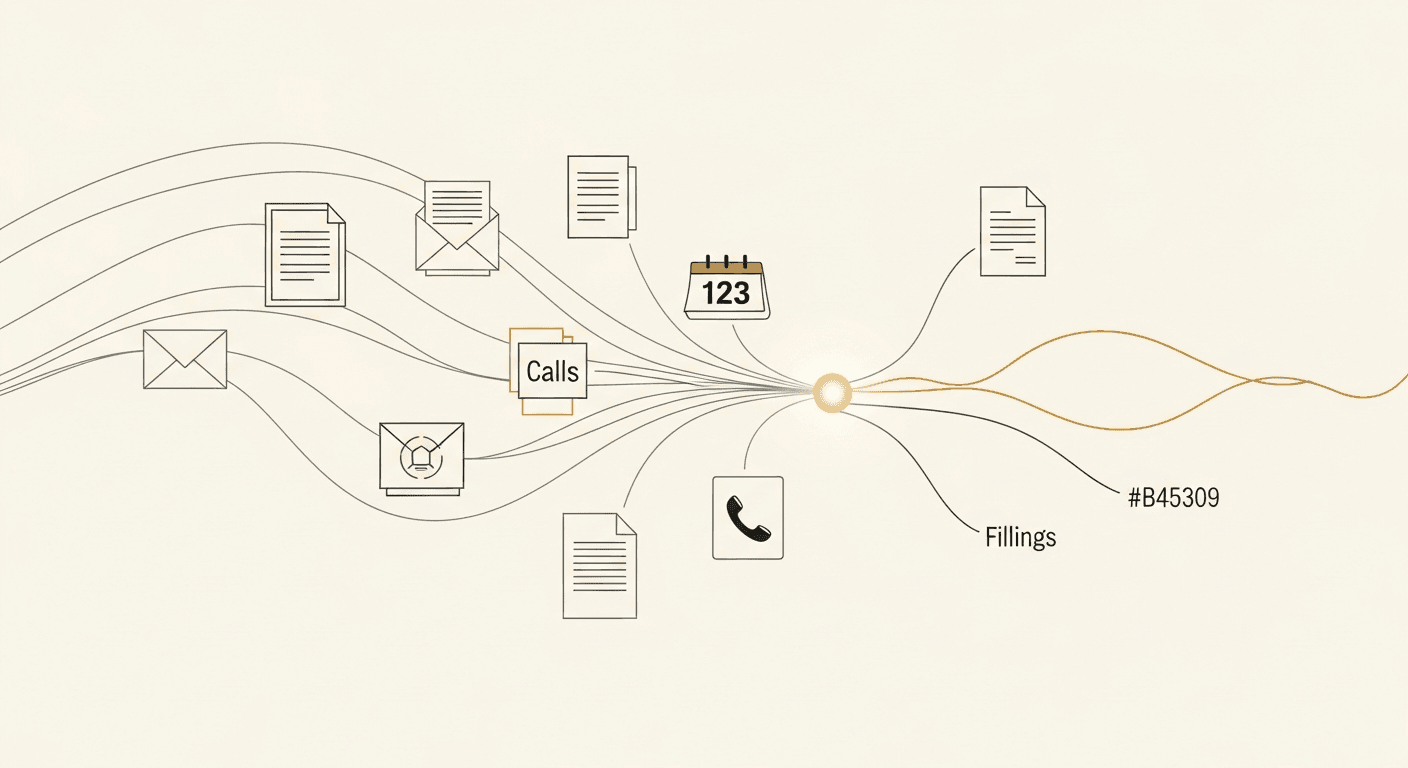
Every email. Every document. Every meeting. Every deadline. Captured durably, prepared automatically, managed end to end.
You focus on strategy. We handle everything else.
The current generation of legal tech bolts AI onto yesterday's workflows. We are not that.
FirstLast.AI is the substrate your practice runs on. Every interaction with every client — email, text, phone, video, document, calendar — flows through one shared intelligence layer. Every artifact your practice produces becomes part of the closed loop that prepares the next move.
You don't log in. It runs in the background.

Every client, every case, every matter in one durable, queryable case memory. Nothing falls between sessions.
Email, text, phone, Zoom. Every conversation transcribed, summarized, action items extracted, deadlines flagged. Both you and your client get the to-do list automatically.
Intake, drafting, sending, filing — handled. You review and approve, you don't pull together. The calendar resolves conflicts before you see them.
Public-record research runs on frontier models (Claude, GPT, Gemini) with citation verification. Client-confidential research runs on local models on your machine — no data leaves your hardware. Privilege is preserved by design, not by policy.
Every meeting transcript, every email, every document feeds the next decision. The AI surfaces what's slipping, what's at risk, what to do next. You stay in strategy mode. The machinery handles itself.

Emails, calls, transcripts, documents, filings, notes — captured into a single intelligence layer the moment they happen.
No decision is made without the AI knowing the context. No action is taken without the AI remembering the outcome. The loop closes itself.
MCP servers, REST APIs, CLI access. Your practice doesn't run on a vendor's GUI — it runs on primitives you can compose.
Frontier models for public research, drafting, reasoning. Local models for anything that touches privileged client data. The model choice is the privacy boundary.
One lawyer with FirstLast.AI handles the case load of five. Not by working harder. By working with an intelligence layer that scales with the work.
You open your laptop. The companion has already summarized overnight emails from clients across four matters, flagged two filing deadlines moving up, and drafted three responses for your review.
You meet a new client over Zoom. The conversation is transcribed live. By the end of the call, the client has a to-do list, you have a case packet, and the next steps are on both your calendars.
A document arrives via email. It's ingested automatically, summarized against the case memory, flagged as relevant to the protective-order matter you're working on. A draft response is in your queue.
You ask the companion: “What's slipping on the Rodriguez matter?” It surfaces the three things you forgot about and the one thing the opposing counsel hasn't replied to. You decide what to do. It executes.
Filing prep for tomorrow morning. The companion has assembled the exhibit appendix, redacted privileged sections, formatted to court rules, and run a citation cross-check. You review the PDF, approve, file.
Strategy was your job. Everything else, the operating system handled.

Sensitive client data — case memory, privileged communications, anything covered by attorney-client privilege — runs on local models on your hardware. Nothing about a client's matter ever leaves your machine without explicit consent.
Public research, drafting boilerplate, formatting, calendar coordination — these run on frontier models in the cloud. The split is enforced by the system, not by your discipline.
You stay compliant by design.
The lawyers who adopt the AI-native model will operate at a thousand times the speed of the lawyers who don't.

This is not hyperbole. It's the same thesis a generation of AI investors are betting on across every service industry — that the practitioners who run their practice as an AI system will outcompete those who treat AI as a feature.
We built FirstLast.AI because we believe legal work, done right, is one of the highest-leverage applications of this thesis. And we want to build it with you.
We're selecting the first cohort now. Immigration, criminal defense, civil litigation, protective-order, family. If your practice fits — and you want to be one of the first lawyers running on an AI-native operating system — get in touch.